
Geary County Criminal Docket Searches
Need a state criminal case filed in Geary County? Kansas CaseSearch is the main online index. Set the court level to District. Pick Geary County (GE) as the location. A case number narrows the search best. When the number is unknown, Party Name works, and the Criminal filter trims unrelated hits. The portal returns basic case information only. It does not make every filed document downloadable. Its result is not a certified court record.
Know which court holds the case before you search. Felonies, state criminal matters, probation revocations, and district-level misdemeanors sit with the Geary District Court. Junction City, Grandview Plaza, and Milford ordinance cases stay with each city court. Skip this split. A blank state result can get mistaken for proof that no city case exists.
- Open CaseSearch, accept its terms, and choose District and Geary County (GE).
- Choose Case Number when known. Otherwise use Party Name and add the Criminal case-type filter.
- Complete the human check, run the search, and compare the court, filing date, and case type.
- Read the events in order. Separate a filed charge or motion from a later plea, order, disposition, or sentence.
- For a document or authenticated result, use the courthouse terminal or ask the Geary clerk for the specific copy.
Three Geary Criminal Access Layers
Criminal docket access in Geary County works in three layers. CaseSearch is the online index. The courthouse public terminal is the second layer. It opens public information and documents that never reach the web. For copies, Cindy Fessman, Clerk of the District Court, handles written court-record requests. The clerk counter and terminal sit at 138 E. 8th Street in Junction City. Call 785-762-5221; the court's phone tree includes a criminal-records option.
A written request lands best when it names Geary County, the criminal case type, and a date range. Include the case number if known, the exact document or event, and whether a plain or certified copy is needed. The Kansas court-record request form fits that route. Staff will not do research needing legal judgment. A broad request may bring research time, a cost estimate, and prepayment.
Access flow: CaseSearch index › courthouse public terminal › clerk request for a named document or certified copy.
Note: A public terminal can show more than the web does, yet it still will not unlock a sealed or nonpublic Geary County criminal record.
Criminal Dockets: What They Show
Think of a Geary County criminal docket as an events index, not a story. Its lines may cover the case number, filing date, public charge descriptions, party roles, attorneys, the assigned judicial officer, settings, motions, pleas, orders, disposition, sentence, and money entries. Each line means only what it says. A motion entry records a request, not a ruling. A plea is not a sentence. A setting means time was reserved, not that the hearing happened as first planned.
| Case Number | The court identifier for one proceeding. Use the exact displayed value rather than inventing a sample format. |
|---|---|
| Charge | A public offense or statute description. Filing does not establish guilt or final outcome. |
| Hearing Setting | A date, time, judge, and event type such as arraignment, motion, revocation, or sentencing. |
| Plea and Orders | Separate events recording a formal response and later court rulings. |
| Disposition | The recorded resolution of a charge or case, which may differ from a later sentencing entry. |
Calendars and case files answer different questions. The Eighth District docket page links a reference PDF for settings. A journal entry, order, or sentence document lives in the case record. Can the short index wording not answer the question? Request that specific filed document instead of guessing from a status label.
Geary Criminal Setting Clock
The Eighth Judicial District's 2025 court-day material offers a helpful model for reading setting labels. It slots arraignment and status work around 9:00 a.m. Revocations and motions land around 10:00 a.m. Sentencing or 50% review follows around 11:00 a.m. Those blocks show why two entries on one day can serve very different purposes. Treat them as district schedule examples. They are not a promise that every current Geary County criminal case keeps those hours.
- Arraignment
- A stage at which charges are addressed and a plea or next step may be recorded.
- Revocation
- A proceeding concerning whether an existing release, probation, or other status should change.
- Motion
- A request for court action. The filing itself is not the ruling.
- Sentencing
- The proceeding where punishment or conditions are imposed after a plea or adjudication.
Criminal settings move fast. The district warns that its docket PDF is for reference, and recent continuances may not be processed yet. Before relying on a published slot, confirm the Geary County criminal hearing with the clerk.
Criminal Case Stages on the Docket
A criminal case opens with an initiating event. After that, the docket may show a first appearance, arraignment, bond activity, pretrial settings, motions, a plea or trial, disposition, and sentencing. Not every case hits every stage. A continuance adds a setting without changing the charge or the outcome. Bond and warrant entries can shift while the case stays pending. Read each date next to its event text. Then pull the later order when access allows.
Geary docket flow: Filing › Arraignment › Pretrial › Plea or Trial › Disposition › Sentencing.
Handle disposition with care. Dismissal, a plea-based result, judgment after trial, and other closures are different outcomes. A closed status alone may not say why the case ended. A sentence may also post after the disposition event. Trust the chronological Geary County criminal docket over any single isolated line.
Geary Recovery Court Context
Geary County belongs to the Eighth Judicial District. The district runs a Recovery Court program for nonviolent drug offenders. Treatment comes first. The public description stresses close supervision, a court team, accountability, sobriety, and reduced repeat offending. That is its whole story. It publishes no roster, and the official page shows only how the program works. Recovery Court is not a separate criminal-case database. It cannot replace a Geary County criminal docket search.
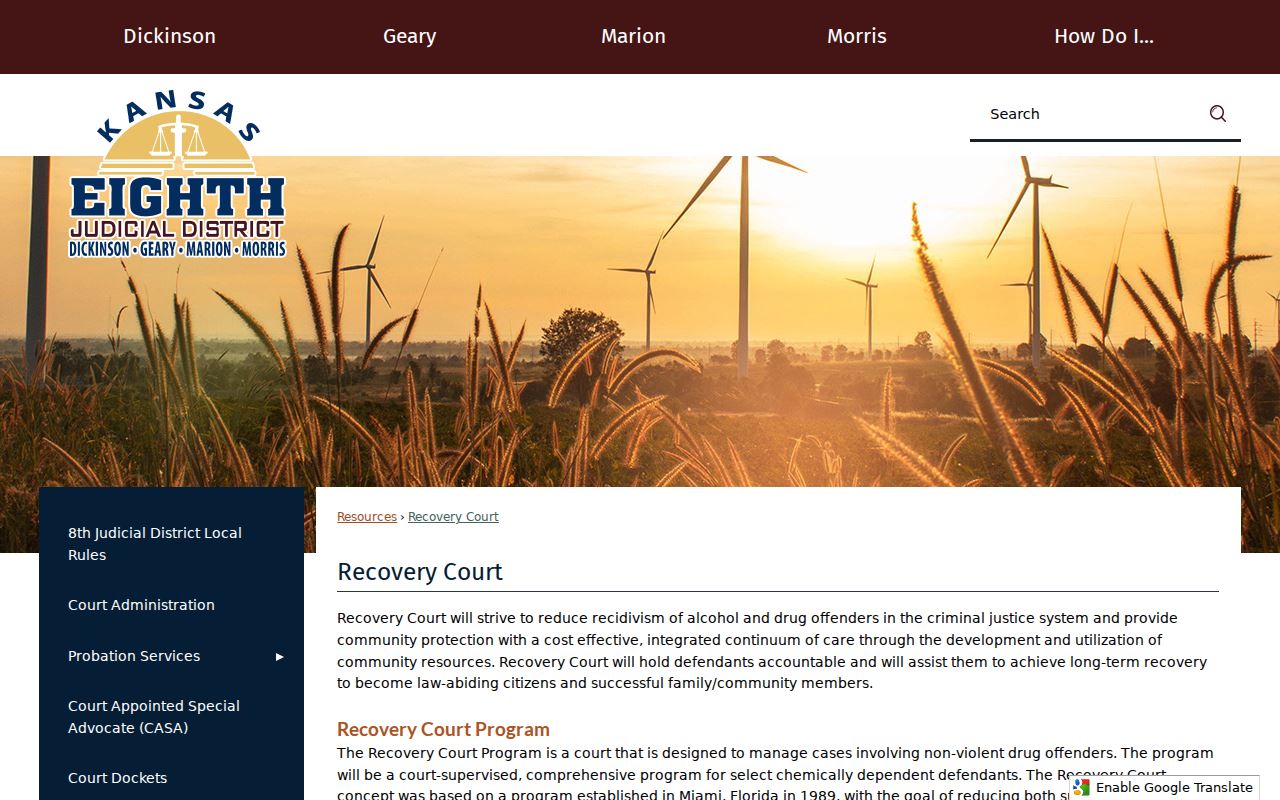
Here is the boundary worth remembering. Program facts are public. Participation in a case is not. Anyone can learn what Recovery Court offers. Each participant's Geary County criminal case stays under the normal court access rules.
Program involvement can add hearings, reviews, orders, or disposition events to an eligible case. The underlying docket still belongs to the Kansas District Court. It remains governed by Kansas access law. A payment portal, a treatment page, and a court docket each do a different job.
Geary County Criminal Docket Courts
State criminal cases in Geary County belong to the Kansas District Court. Geary shares the Eighth Judicial District with Dickinson, Marion, and Morris Counties under K.S.A. 4-209. District judges and magistrate judges work within one state trial-court system. An assignment shows who handles a setting. It does not show the outcome.
Municipal courts keep their own dockets. Junction City Municipal Court takes city ordinance violations, city traffic, and misdemeanor matters. Grandview Plaza and Milford run separate channels. Federal cases are different again. They never appear in Kansas CaseSearch. Federal charges belong to the U.S. District Court for the District of Kansas and the PACER system. So match the docket to the law and court the case was filed under, not just the place where the conduct occurred.
Geary Docket, Not History Check
A criminal-history record is not a Geary County court docket. The docket is the court's own index and events trail. The Kansas Bureau of Investigation runs the history system. But the Judicial Branch directs history requests to that separate system. An executive-branch history record cannot replace the filed charges, hearings, orders, and disposition. Those live in a district court file.
Police and prosecution files follow the same split. An investigation file may sit with a law-enforcement agency or a prosecutor. The district clerk holds the filed court case. The Central Payment Center is a third lane. It accepts eligible payments but never shows a full Geary County criminal docket.
Use the docket to track a known case. It can confirm an event or explain the judicial process. For the wider workflow, the Geary County docket search page covers the state portal fields. It also walks through the courthouse fallback.
Geary Criminal Payments Stay Separate
The Kansas Courts Central Payment Center accepts eligible criminal, traffic, juvenile-offender, and fish and game payments. Payment is its only job. It does not run a Geary County criminal docket search. Reaching a payment screen tells you nothing about the full events index, the filed orders, or the current hearing setting. Viewing the public basic CaseSearch index costs nothing.
Before paying, match the case number and county to the official court notice. Copy questions go to the clerk. Payment questions follow the payment channel. Keep the tasks apart. You will not mistake a receipt for a docket or a docket result for a balance.
Access Rules for Criminal Dockets
Kansas Supreme Court Rule 22 draws a line between the public internet portal and the courthouse terminal. A public case may show an events index online. The terminal offers more public information. Documents come by request. Sealed and nonpublic records stay unavailable at both levels. Presentense material, unserved warrants, search-warrant affidavits, grand-jury records, juvenile information, expunged cases, and other protected matter may be withheld by statute, rule, case law, or court order.
Key access rules
Kansas Supreme Court Rule 22 creates portal and courthouse-terminal access levels and confirms that not all public records appear online.
K.S.A. 45-221 identifies record exceptions and calls for open and closed portions to be separated where practical.
The official arrest-record expungement statute is the source of the second assigned image.
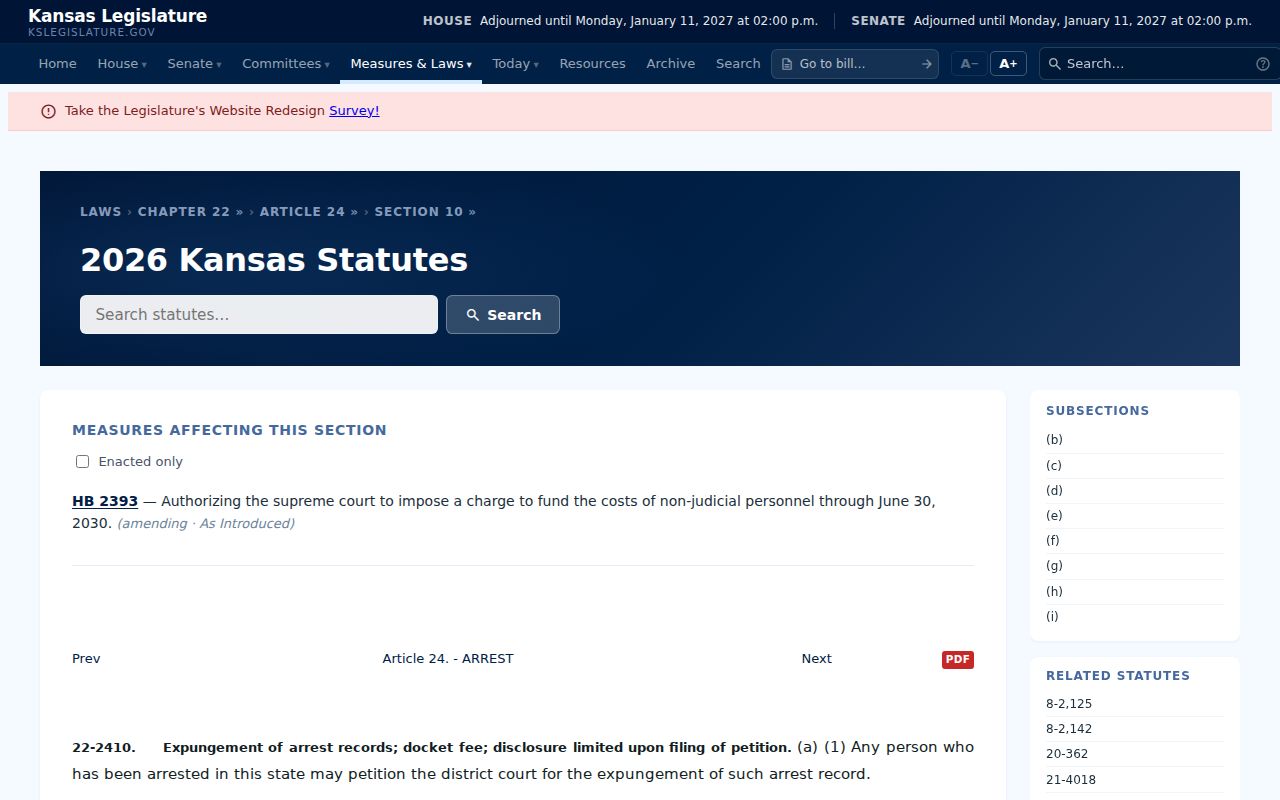
Expungement is a court process. It takes notice and an order. It is not an informal request to erase a public web listing.
A missing criminal case raises three questions. Is it public but not online, filed in a municipal court, or restricted by law? Never try to rebuild a sealed or expunged file from outside sources. The Geary clerk can point to the authorized route. The clerk cannot give legal advice or disclose material barred by law.